Financial and Go-To-Market Excellence
Executing a successful Go-To-Market (GTM) for a company or new product is probably one of the hardest things for any organisation to accomplish. We make sure CEOs, CFOs, founders and GTM teams have the right data at their fingertips to avoid common mistakes, diagnose any ongoing issues, and course correct if necessary.
Go-To-Market Excellence
When working with B2B clients, we frequently use our CTKC GTM Framework to describe, assess, and drive commercial GTM excellence. We often also use this as an onboarding tool or to evaluate whether we can work with a client, or not. This framework divides the GTM into 4 phases and 16 stages.
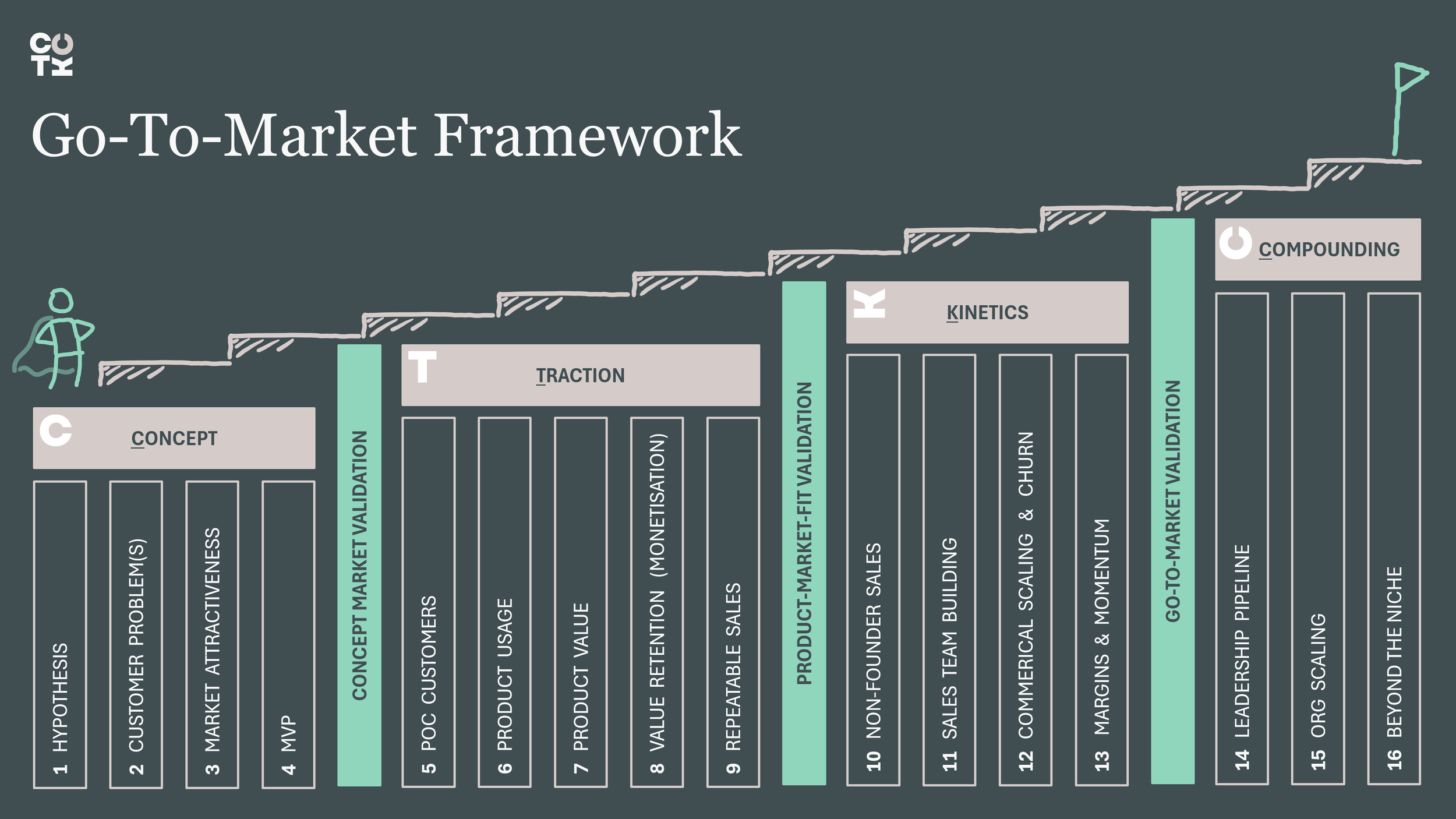
The four phases are:
-
The Concept phase is about formulating a market or product hypothesis, understanding the customer problems that need solving, determining whether there is a viable, attractive market, and to develop some sort of prototype or MVP to validate the hypothesis and all other assumptions with.
If the company as mastered this phase, they will have achieved Concept-Market-Validation.
-
The Traction phase is all about proving or disproving (and amending) the hypothesis. It’s about having a small number of revenue-generating POC customers who use the product and through whom the company can quickly validate their product’s usefulness and value - and how that value might be monetised. Finally, it is then about proving that other customers beyond the initial POC customers also see that value and decide to buy the product.
By the end of this phase, the company will have achieved their Product-Market-Fit.
-
Once there is a clear Product-Market-Fit, the Kinetics phase is all about creating a self-driving, self-perpetuating momentum with an organisation that can operate without constant founder-/CEO-energy and input.
This phase is about having a sales play-book that works for ordinary non-founder sales types, building out a high-performing sales team, and proving that the unit-economics of the offering stack-up: i.e. that the offering can scale. If they do, then profit margins will improve and momentum will gather pace.
If the company succeeds, it will have validated its GTM.
-
Finally, this last phase is about compounding the success of the company, doubling down on what really works, and branching out into adjacent offerings and market segments. At this stage, the GTM organisation will need to mature, which means bringing on new talent and new executive leadership who know how to run and operate large corporations effectively and who can establish new processes and structures to support continued growth.
Diagnosing GTM Gaps
At CTKC, we use our GTM framework to analyse whether our clients’ commercial maturity is at the level to succeed at the stage they are trying to operate at. Gaps occur when companies think they are further along their GTM journey than they really are. For example, if a company has just hired a sales team but is seeing long sales cycles and low conversions, then that can be because it hasn’t sufficiently validated and quantified the value their product generates for their customers.
There can be many reasons why a GTM stalls. That is why being able to diagnose the heart of the problem quickly is imperative. The sooner executives can take the right measures to fix what is wrong, the better.
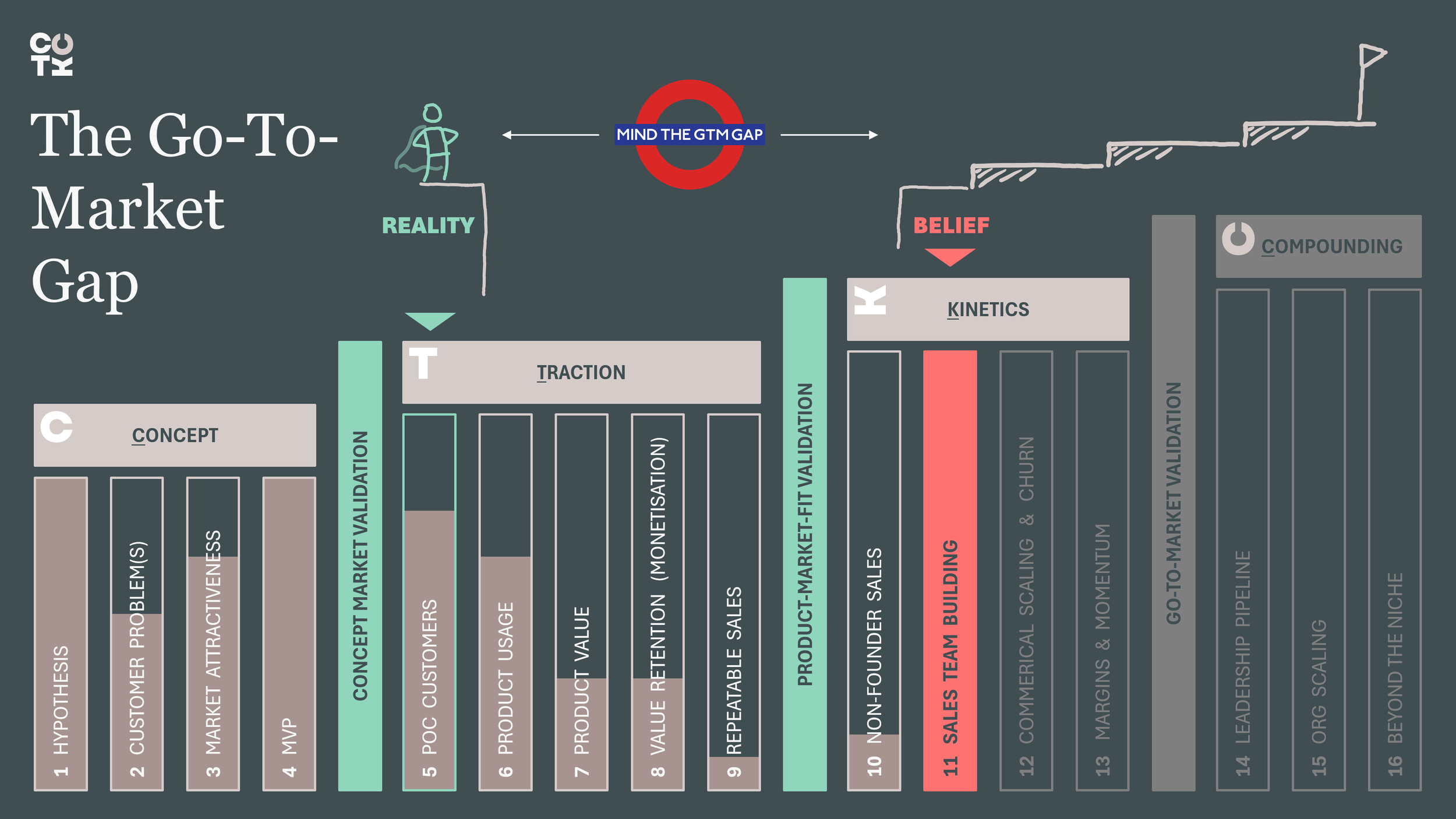
For this purpose, we have developed our GTM Readiness Check which is a simple self-evaluation executives can complete. It allows us to identify the GTM Gaps a company may have on Day 1, and very quickly put together an action-plan of measures the company can take to mitigate and address these issues. We often use the Readiness Check to on-board new clients as well.
Common GTM Gaps are:
The Series-A Illusion,
The Commercial Pipeline-Dream,
The Retention Nightmare, and
The Enterprise Building Migrane.
Over the coming months, we will be publishing more on those GTM Gaps, how we diagnose them, how they affect businesses, and what we might do to mitigate them.
If you’re interested in completing the Readiness Check for your own organisation, you can do so by clicking on the button below:
Building Commercial Excellence
Once we have established a client’s GTM maturity with the help of our GTM Readiness Check, we create a roadmap with our client to address and close any GTM gaps. The roadmap may include:
Reevaluating how attractive the market is,
Measuring to what extent the current solution solves the customer problem,
Finding out which product features generate the biggest value for customers,
Putting a $ value on the value generated for customers,
Determining what the best-performing sales channels are,
Etc.
We also look at aspects such as Sales Team and Executive Team composition, as well as management KPIs. This includes looking at how sales team meeting cadences, topics and agendas tie into overall executive team meeting cadences, topics, agendas as well as how issues are identified, escalated, tracked, management and resolved.
The reason we look at this holistically, is because regardless of company size, sales is everybody’s business. To put it bluntly: if the people building or providing products and services for your customers are not involved with or thinking about sales, you are effectively running a country club for those individuals - not a commercial enterprise. In the best-case scenario, this leads to complacency in your product and service teams. In the worst case, you will end up with products and services no one needs, and no one will pay for.
This is why we always take a holistic approach to commercial excellence, and make sales and the customers’ needs central to how you operate as a business.